Love this? Save it for later!
Share the inspiration with your friends
I was standing in the produce section of my local grocery store last November when a woman next to me picked up a persimmon, turned it over in her hand, and put it back with a little sigh of confusion. “I never know what to do with these,” she said, mostly to herself. I almost said something, but then the smell hit me—that sweet, almost honeyed scent, so faint you might miss it if you weren’t paying attention. And suddenly I was six years old at my neighbor Mrs. Kowalski’s kitchen table, watching her slice into a persimmon with the same careful reverence other people reserved for heirloom tomatoes.
Mrs. K, as we called her, was Polish and made a persimmon bread every fall that filled her whole apartment with a warmth I can still almost feel on my skin. She passed away when I was twelve, and I never got her recipe. For years I tried to recreate it from memory—the tender crumb, the little crunch of walnuts, that bright something that I later figured out was orange zest. I messed up a lot of batches. Some were too dry, some too dense, one was so wet in the middle it basically qualified as pudding.
Honestly, I almost gave up. But then last winter, on a rainy Tuesday when I was supposed to be working on something else entirely, I tried one more time. I had three overripe persimmons on the counter and nowhere to go. Maybe you’ve been there—that stubborn feeling where you just know a recipe is in you somewhere, waiting to come out. This time, I got it. The moment I pulled this bread from the oven, that old familiar scent wrapped around me like a hug, and I knew I had finally found my way back to Mrs. K’s kitchen.
Why You’ll Love This Recipe
This isn’t just another quick bread recipe. After about twelve test batches (and one memorable disaster involving a forgotten baking soda), I can tell you this version is the one. Here’s why it’s worth the spot in your recipe collection:
- Perfectly moist without being soggy. Persimmons are tricky—too ripe and your bread turns into a brick of wet sadness. This recipe nails the balance, giving you a tender crumb that stays moist for days.
- Pantry-friendly ingredients. You probably have everything except the persimmons already. No weird flours or specialty extracts. Just real, simple stuff.
- That warm, cozy fall feeling. The combination of orange zest and walnut creates this incredible aromatic experience. It’s the kind of bread you want with a cup of tea when the leaves are changing.
- Impresses everyone without stress. I brought this to a potluck last month and three people asked for the recipe. It looks fancy with the walnut topping but comes together in one bowl.
- Freezes beautifully. Make two loaves—one for now, one for later. The flavor actually gets better after a day or two.
What makes this different from other persimmon breads? It’s the texture, honestly. Most recipes end up too dense or too wet. I spent a long time figuring out the right ratio of persimmon pulp to flour, and the trick of letting the pulp sit with the sugar for a few minutes before mixing. That little step changes everything—it draws out the natural pectin and gives the bread a structure that holds up without being heavy.
This is the kind of bread that makes you close your eyes after the first bite. It’s comfort food at its simplest—the taste of late autumn, a quiet afternoon, and a memory you didn’t know you were still carrying.
What Ingredients You Will Need
This recipe uses simple, wholesome ingredients that come together to create something truly special. The persimmons do most of the heavy lifting here, so getting them right matters more than anything else.
- Ripe Fuyu persimmons, about 4 medium (you’ll need 1 cup of pulp). Look for ones that are soft to the touch but not mushy. The skin should be a deep orange with no green. Hachiya persimmons work too, but they must be incredibly soft—almost jelly-like—or they’ll be too astringent.
- All-purpose flour, 1 and 3/4 cups (210 grams). Spoon and level it—don’t scoop directly from the bag or you’ll pack in too much.
- Granulated sugar, 1 cup (200 grams). Regular white sugar works perfectly here. The persimmons add sweetness too, so don’t be tempted to add more.
- Unsalted butter, 1/3 cup (75 grams), melted and slightly cooled. I use Kerrygold when I can find it—the higher fat content makes the crumb softer.
- Large eggs, 2, at room temperature. Cold eggs will seize the melted butter. Leave them on the counter for 30 minutes or float them in warm water for 5.
- Vanilla extract, 1 teaspoon. Pure vanilla, not imitation. It makes a real difference here.
- Orange zest, from 1 large orange (about 1 tablespoon). Use a microplane if you have one—the zest is finer and releases more oils. Avoid the white pith.
- Fresh orange juice, 2 tablespoons. Squeeze the orange you zested. Fresh only, please.
- Baking soda, 1 teaspoon. Make sure it’s fresh—test it by dropping a little in vinegar. If it fizzes vigorously, you’re good.
- Salt, 1/2 teaspoon. Fine sea salt or table salt. I prefer fine sea salt for baking—it dissolves more evenly.
- Ground cinnamon, 1 teaspoon. I use Saigon cinnamon when I can find it—it’s stronger and more aromatic than standard cassia.
- Ground nutmeg, 1/4 teaspoon. Freshly grated if you have it, but pre-ground works fine.
- Ground ginger, 1/4 teaspoon. Adds a little warmth without being spicy.
- Walnuts, 1 cup (120 grams), toasted and roughly chopped. Toast them in a dry skillet over medium heat for 3-4 minutes, stirring constantly. Let them cool completely before adding to the batter.
- Optional for topping: 1/4 cup chopped walnuts and 1 tablespoon coarse sugar (like turbinado or demerara).
For the persimmons, I’ve found that Fuyu persimmons are more forgiving and easier to find in most grocery stores. If you’re using Hachiya, make sure they’re so soft they practically collapse when you touch them. Unripe Hachiya will make your mouth feel fuzzy—not a good look for a cozy bread recipe.
Equipment Needed
You don’t need a fancy kitchen for this one. Here’s what you’ll need:
- 9×5-inch loaf pan. Glass or metal both work. I prefer a light-colored metal pan for even browning. Dark pans can make the crust too dark before the center is done.
- Parchment paper. Cut a strip to fit the length of the pan with overhang on both sides—this is your sling for lifting the bread out cleanly.
- Large mixing bowl. Any bowl will do, but a wide one makes mixing easier.
- Medium bowl for whisking dry ingredients.
- Whisk and rubber spatula. A wooden spoon works too, but the spatula helps you scrape every bit of batter.
- Microplane or fine grater for the orange zest. A box grater’s small holes work in a pinch.
- Measuring cups and spoons. If you have a kitchen scale, use it for the flour—it’s more accurate and you’ll get better results every time.
- Cooling rack. Essential for even cooling. If you don’t have one, you can use the oven grates (just make sure they’re clean).
- Food processor or blender for pureeing the persimmons. A fork works if they’re very soft, but the processor gives you a smoother pulp.
I’ve made this bread with a cheap loaf pan from the dollar store and it still turned out fine. Don’t let equipment stop you. But if you bake often, a good quality loaf pan is worth the investment—mine’s a USA Pan and it’s never let me down.
Preparation Method
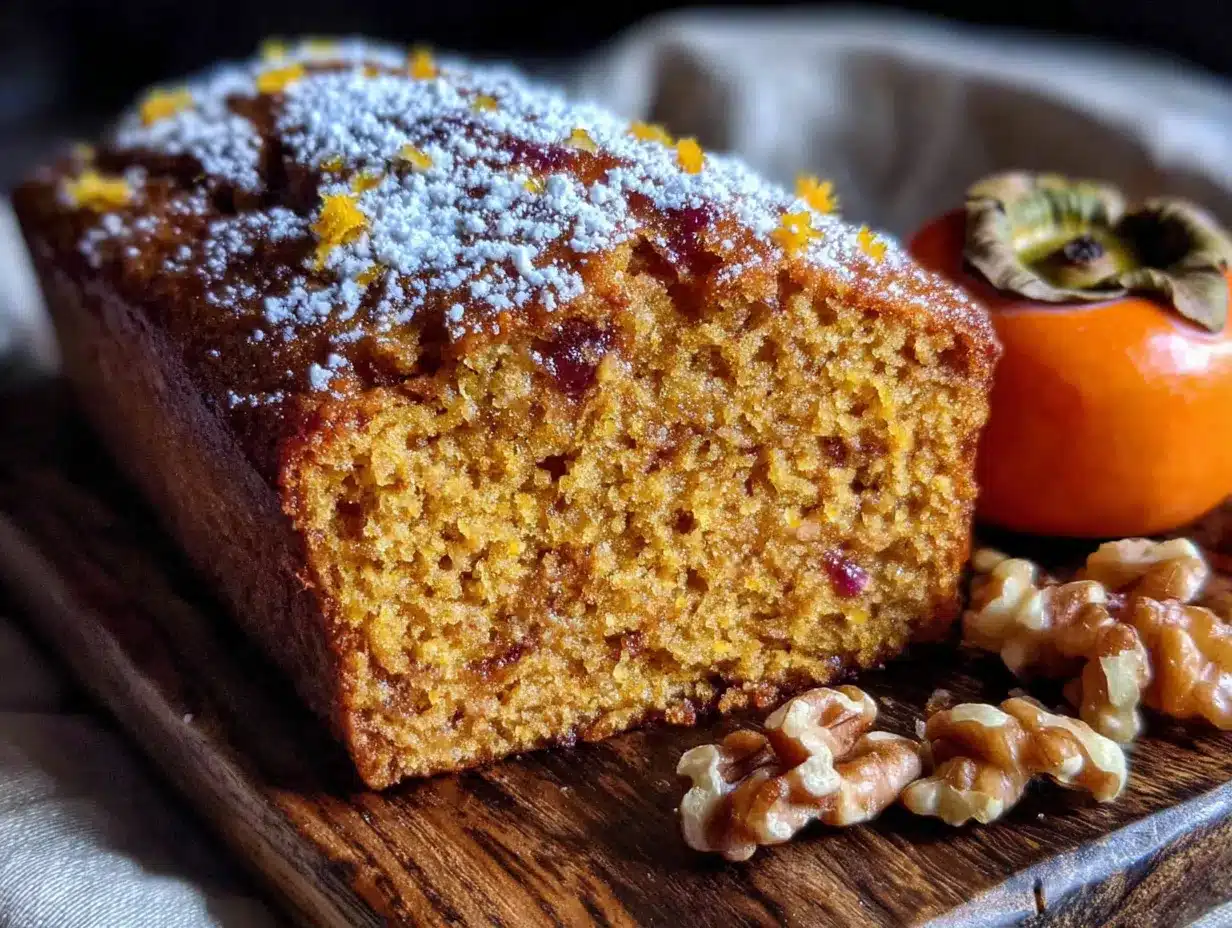
Let’s get baking. Take your time with each step—rushing is the fastest way to a disappointing loaf.
- Preheat your oven to 350°F (175°C). Position the rack in the center. While it’s heating, line your loaf pan with parchment paper, leaving about 2 inches of overhang on the long sides. Lightly grease the short sides with butter or non-stick spray.
- Prepare the persimmons. Wash them well, cut off the green calyx (the leafy top), and cut them into quarters. If using Fuyu persimmons, you can leave the skin on—it’s edible and adds a little texture. For Hachiya, scoop out the soft flesh and discard the skin. Place the pieces in a food processor and pulse until you have a smooth puree. You should have about 1 cup. Set aside.
- Toast the walnuts. Spread the walnuts on a baking sheet and toast in the preheated oven for 5-7 minutes, shaking the pan halfway through. You’ll know they’re done when they smell nutty and look slightly darker. Let them cool completely. This step is non-negotiable—raw walnuts are fine, but toasted walnuts are where the magic happens.
- Mix the wet ingredients. In a large bowl, combine the persimmon pulp and granulated sugar. Stir them together and let them sit for 5 minutes. This is the trick I mentioned earlier—it helps the pectin activate and gives the bread a better structure. Then whisk in the melted butter, eggs, vanilla extract, orange zest, and orange juice until everything is smooth and well combined.
- Whisk the dry ingredients. In a separate medium bowl, whisk together the flour, baking soda, salt, cinnamon, nutmeg, and ginger. Make sure there are no lumps. I like to use a fork for this—it breaks up clumps better than a whisk sometimes.
- Combine wet and dry. Pour the dry ingredients into the wet mixture. Fold gently with a rubber spatula until just combined—about 10 to 12 strokes. You’ll still see a few streaks of flour, and that’s okay. Overmixing will make the bread tough.
- Fold in the walnuts. Add the cooled, toasted walnuts and fold them in with just a few more strokes. Don’t overdo it. The batter will be thick and slightly lumpy—that’s the texture you want.
- Transfer to the pan. Scrape the batter into the prepared loaf pan and spread it evenly. If you’re using the optional topping, sprinkle the extra chopped walnuts and coarse sugar over the top. Run your finger gently through the center of the batter lengthwise to create a slight indentation—this helps the bread rise evenly with a nice crack down the middle.
- Bake. Place the pan in the preheated oven and bake for 50 to 60 minutes. At the 30-minute mark, check the top—if it’s browning too quickly, tent the pan loosely with aluminum foil. The bread is done when a toothpick inserted into the center comes out clean or with just a few moist crumbs. If it comes out wet, give it another 5 minutes and check again.
- Cool. Let the bread cool in the pan on a wire rack for 15 minutes. Then use the parchment sling to lift it out and transfer it to the rack to cool completely. Don’t slice it while it’s warm—it will fall apart. I know it’s hard to wait, but trust me on this. Give it at least an hour.
Cooking Tips & Techniques
I learned most of these the hard way, so you don’t have to. Here’s what I wish someone had told me before my first attempt:
Don’t rush the persimmon ripening. If your persimmons aren’t soft enough, put them in a paper bag with a banana for a day or two. The ethylene gas from the banana will speed things up naturally. I once tried to use slightly underripe persimmons because I was impatient, and the bread had a weird astringent aftertaste that no amount of sugar could fix.
Measure your flour correctly. This is the most common mistake in quick breads. Spoon the flour into your measuring cup, then level it off with a knife. Scooping directly from the bag compacts the flour and you’ll end up with up to 25% more than you need. That extra flour makes the bread dry and dense. I speak from experience—my first three loaves were edible but sad.
Room temperature eggs matter. Cold eggs will seize the melted butter and create lumps in your batter. If you forgot to take them out early, place them in a bowl of warm (not hot) water for 5 minutes. They’ll come to temperature quickly without cooking.
Check for doneness with a thermometer. If you have an instant-read thermometer, the internal temperature should be around 200°F (93°C) when the bread is done. This is more reliable than the toothpick test, especially if you’re new to baking quick breads.
Let it rest overnight. Honestly, this bread is even better the next day. The flavors meld together and the texture settles into something almost cake-like. Wrap it tightly in plastic wrap once it’s completely cool and let it sit on the counter overnight. Then slice and serve. If you can wait that long.
Variations & Adaptations
This recipe is flexible. Here are some ways to make it your own:
Gluten-free version: Substitute the all-purpose flour with a 1:1 gluten-free baking flour blend that contains xanthan gum. I’ve had good results with King Arthur’s Measure for Measure. The texture will be slightly more crumbly, but the flavor is still there.
Dairy-free option: Use melted coconut oil or a neutral vegetable oil instead of butter. The bread will be a touch less rich, but still delicious. I tried this once when I ran out of butter and honestly, my husband didn’t even notice.
Spice it up: Add 1/4 teaspoon of cardamom or allspice along with the other spices. Cardamom pairs beautifully with orange and persimmon—it’s a combination I discovered by accident when I knocked a jar into the bowl. Turned out to be a happy accident.
Add dried fruit: Fold in 1/3 cup of dried cranberries or chopped dried apricots along with the walnuts. The chewiness adds a nice contrast to the tender crumb. Soak them in hot water for 10 minutes first so they don’t draw moisture from the batter.
Make it a streusel-topped loaf: Mix 2 tablespoons cold butter, 2 tablespoons flour, 2 tablespoons brown sugar, and 1/4 cup chopped walnuts until crumbly. Sprinkle over the batter before baking. This turns it into something closer to a coffee cake, and it’s absolutely worth the extra few minutes.
Serving & Storage Suggestions
This bread is versatile. Here’s how to enjoy it at its best:
Serving temperature: Room temperature is ideal. The flavors are more pronounced than when it’s straight from the fridge. If you’re serving it warm, microwave individual slices for 10 to 15 seconds—just enough to take the chill off without melting the texture.
Perfect pairings: A slice of this bread with a pat of salted butter and a cup of chai tea is my personal favorite. It’s also wonderful with cream cheese spread, a drizzle of honey, or alongside a bowl of butternut squash soup for a cozy fall lunch.
Storage: Wrap the cooled bread tightly in plastic wrap and store at room temperature for up to 4 days. Do not refrigerate—the cold air dries it out and accelerates staling. If your kitchen is very warm, you can store it in an airtight container instead.
Freezing: This bread freezes beautifully. Wrap the completely cooled loaf (or individual slices) in plastic wrap, then aluminum foil, and freeze for up to 3 months. Thaw overnight in the refrigerator or at room temperature for a few hours. The flavor actually improves after freezing—something about the moisture redistributing.
Reheating: For that just-baked experience, reheat slices in a 300°F (150°C) oven for 5 to 7 minutes. The edges get slightly crispy while the inside stays tender. Avoid the microwave for reheating—it makes the bread rubbery.
Nutritional Information & Benefits
Per slice (based on 10 slices): Approximately 285 calories, 12g fat, 40g carbohydrates, 5g protein, 3g fiber, 22g sugar. These are estimates and will vary based on your specific ingredients and portion sizes.
Persimmons are a nutritional powerhouse. They’re packed with vitamin A (great for eye health), vitamin C (immune support), and manganese (bone health). They also contain high levels of dietary fiber, which aids digestion and helps you feel full longer. One persimmon has about 6 grams of fiber—that’s more than an apple.
Walnuts add omega-3 fatty acids, which are fantastic for brain health and reducing inflammation. The orange zest provides additional vitamin C and antioxidants. This bread isn’t health food, but it’s certainly not empty calories either.
For dietary considerations: This recipe contains gluten, dairy, eggs, and tree nuts. For a gluten-free version, see the variations section. For dairy-free, use coconut oil. For nut-free, substitute the walnuts with pepitas (pumpkin seeds) or simply omit them.
Conclusion
This persimmon bread is more than a recipe—it’s a little piece of autumn you can hold in your hands. The sweet, honeyed flavor of ripe persimmons, the warm crunch of toasted walnuts, the bright pop of orange zest—it all comes together in a loaf that feels like a hug on a chilly day.
I’ve made this bread for holiday brunches, quiet Sunday mornings, and as a hostess gift that never fails to impress. Every time I pull it from the oven, I think of Mrs. Kowalski and her tiny kitchen with the yellow curtains. I hope this recipe becomes that for you too—a small tradition, a memory in the making.
Try it once and see how it feels. Play with the spices, swap in different nuts, make it your own. And when you do, I’d love to hear about it. Drop a comment below and tell me how yours turned out—what did you change? What worked? What surprised you? Your feedback helps other readers and honestly, it just makes my day to know this recipe is finding its way into kitchens beyond mine.
Happy baking, friends. And if you’re standing in the produce section staring at a persimmon, confused—now you know exactly what to do.
Frequently Asked Questions
Can I use Hachiya persimmons instead of Fuyu?
Yes, but they must be incredibly soft—almost jelly-like. Unripe Hachiya persimmons are very astringent and will make your bread taste bitter and leave a fuzzy feeling in your mouth. If your Hachiya persimmons are firm, let them ripen at room temperature until they’re very soft before using.
Why did my persimmon bread sink in the middle?
This usually happens for one of three reasons: the batter was overmixed (which develops too much gluten), the oven temperature was too low (causing the bread to rise slowly and then collapse), or the bread was underbaked. Make sure your oven is fully preheated to 350°F and check doneness with a toothpick or thermometer before removing.
Can I make this recipe vegan?
I haven’t tested a vegan version myself, but readers have reported success using flax eggs (2 tablespoons ground flaxseed mixed with 6 tablespoons water, let sit for 5 minutes) and melted coconut oil instead of butter. The texture will be slightly denser, but the flavor is still lovely.
How do I know when persimmons are ripe enough?
Fuyu persimmons should be soft to the touch but not mushy—think of the texture of a ripe plum. The skin should be deep orange with no green tinge. Hachiya persimmons should be very soft, almost like a water balloon. When they’re ready, the skin will look translucent and the fruit will feel heavy for its size.
Can I add chocolate chips to this bread?
Absolutely. Fold in 1/2 cup of dark chocolate chips along with the walnuts. The combination of persimmon, orange, and chocolate is surprisingly good—the chocolate adds richness that complements the fruity sweetness. I’ve done this for a more dessert-like version and it was a hit at my book club.
Pin This Recipe!
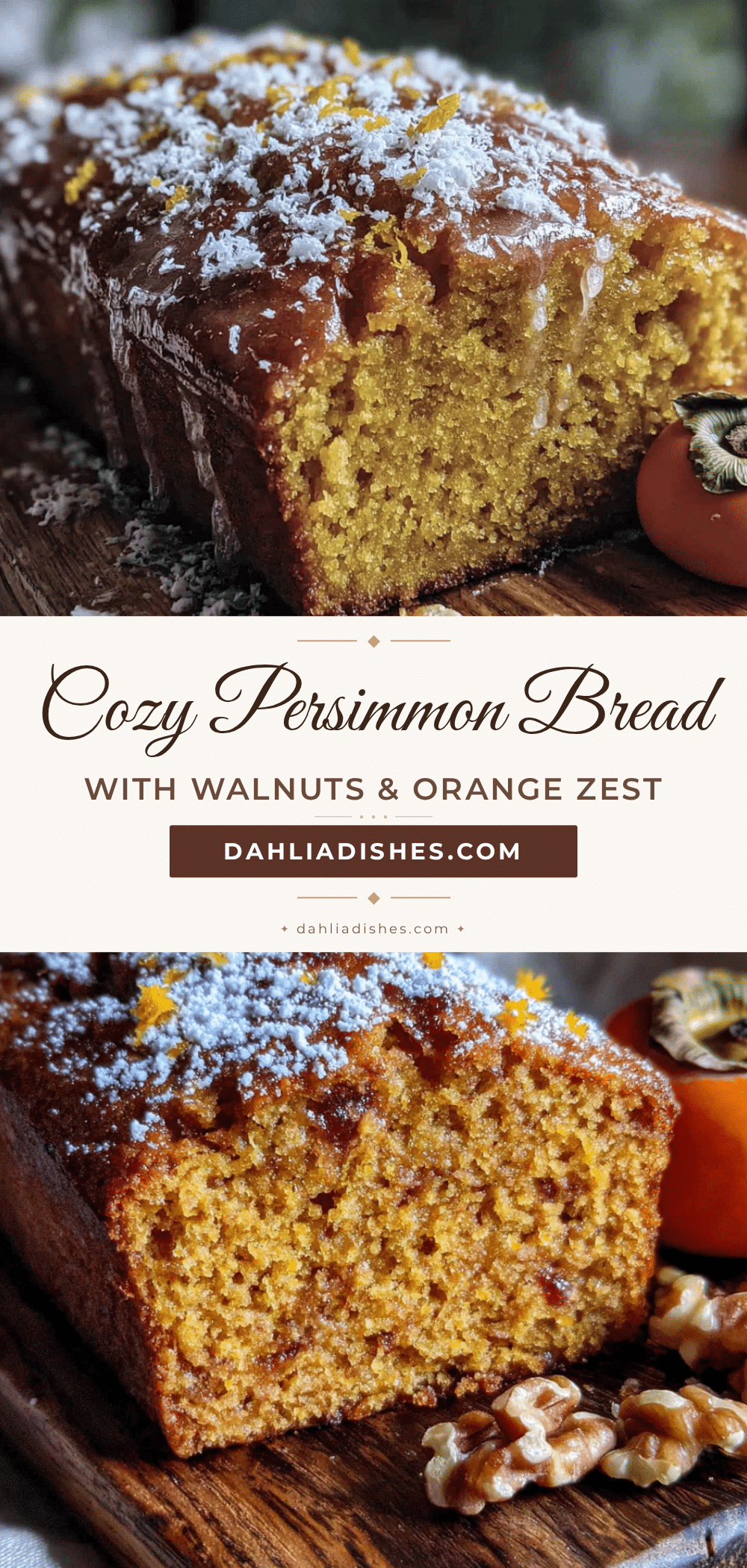
Cozy Persimmon Bread with Walnuts and Orange Zest

A tender, moist quick bread made with ripe persimmons, toasted walnuts, and bright orange zest. This recipe captures the cozy flavors of autumn and is perfect for holiday brunches or a quiet afternoon treat.
- Prep Time: 20 minutes
- Cook Time: 55 minutes
- Total Time: 1 hour 15 minutes
- Yield: 10 servings 1x
- Category: Quick Bread
- Cuisine: American
Ingredients
- 4 medium ripe Fuyu persimmons (about 1 cup pulp)
- 1 3/4 cups (210 g) all-purpose flour
- 1 cup (200 g) granulated sugar
- 1/3 cup (75 g) unsalted butter, melted and slightly cooled
- 2 large eggs, at room temperature
- 1 teaspoon vanilla extract
- 1 tablespoon orange zest (from 1 large orange)
- 2 tablespoons fresh orange juice
- 1 teaspoon baking soda
- 1/2 teaspoon fine sea salt
- 1 teaspoon ground cinnamon
- 1/4 teaspoon ground nutmeg
- 1/4 teaspoon ground ginger
- 1 cup (120 g) walnuts, toasted and roughly chopped
- Optional topping: 1/4 cup chopped walnuts and 1 tablespoon coarse sugar (turbinado or demerara)
Instructions
- Preheat oven to 350°F (175°C). Line a 9×5-inch loaf pan with parchment paper, leaving 2 inches overhang on long sides. Lightly grease short sides.
- Wash persimmons, cut off calyx, and quarter. For Fuyu, leave skin on; for Hachiya, scoop out flesh and discard skin. Puree in food processor until smooth (about 1 cup). Set aside.
- Toast walnuts on a baking sheet in preheated oven for 5-7 minutes, shaking halfway, until fragrant. Let cool completely.
- In a large bowl, combine persimmon pulp and sugar. Let sit for 5 minutes. Whisk in melted butter, eggs, vanilla, orange zest, and orange juice until smooth.
- In a medium bowl, whisk together flour, baking soda, salt, cinnamon, nutmeg, and ginger.
- Pour dry ingredients into wet mixture. Fold gently with a rubber spatula until just combined (10-12 strokes). A few streaks of flour are okay.
- Fold in cooled toasted walnuts with a few more strokes. Batter will be thick and slightly lumpy.
- Scrape batter into prepared pan and spread evenly. If using topping, sprinkle walnuts and coarse sugar on top. Gently create a slight indentation lengthwise down the center.
- Bake for 50-60 minutes. At 30 minutes, tent with foil if browning too quickly. Bread is done when a toothpick inserted in center comes out clean or with a few moist crumbs.
- Cool in pan on a wire rack for 15 minutes. Use parchment sling to lift bread out and transfer to rack to cool completely (at least 1 hour before slicing).
Notes
For best flavor, let the bread rest overnight wrapped tightly in plastic wrap. The texture becomes more cake-like and flavors meld. Do not refrigerate; store at room temperature for up to 4 days. Freezes well for up to 3 months.
Nutrition
- Serving Size: 1 slice
- Calories: 285
- Sugar: 22
- Sodium: 220
- Fat: 12
- Saturated Fat: 4
- Carbohydrates: 40
- Fiber: 3
- Protein: 5
Keywords: persimmon bread, persimmon recipe, fall baking, quick bread, walnut bread, orange zest, autumn recipe, easy bread