Love this? Save it for later!
Share the inspiration with your friends
I had a rule for years. No prime rib. It wasn’t that I didn’t like it—I refused to make it. The price tag alone made me nervous, and I’d watched enough cooking shows to know that one wrong move with a roast that expensive could ruin a whole holiday. I stuck to turkey, ham, even a giant lasagna one Christmas just to avoid it. Then my brother-in-law, Mark, showed up at Thanksgiving three years ago carrying a twenty-pound prime rib he’d bought on a whim. “Figure it out,” he said, setting it on my counter. I wanted to throw a dish towel at his head. But I figured it out. And honestly? I’ve been making it ever since. That first roast came out a little overdone on the ends and the jus was too salty, but the middle slices—those perfect pink slices—made everyone at the table go quiet. Mark looked at me, chewing, and just raised his eyebrows. I didn’t say a word. I just smiled. This Perfect Garlic Herb Prime Rib Roast with Red Wine Jus is the version I landed on after that first trial-and-error holiday. It’s the one I make when I want to prove something to myself, and the one that keeps getting requested every single year. Maybe you’ve been there—staring at a beautiful cut of beef, hoping you don’t mess it up. Let me tell you, this recipe makes it almost impossible to fail.
Why You’ll Love This Recipe
This isn’t just another roast recipe. It’s the one I tested five times before I got the crust exactly right, and the one that convinced Mark—and everyone else—that I actually knew what I was doing. Here’s why it works:
- Foolproof Technique : The reverse-sear method means you get evenly cooked meat from edge to center, no gray bands or raw spots. I’ve burned through three meat thermometers perfecting this, and I can promise you it works every time.
- Simple Ingredients, Big Flavor : You don’t need a dozen exotic spices. Garlic, fresh herbs, butter, and a good bottle of red wine do all the heavy lifting. Your grocery list is short, but the payoff is huge.
- Perfect for Special Occasions : Christmas dinner, New Year’s Eve, a milestone birthday—this roast makes any gathering feel like a celebration without chaining you to the stove. You get to enjoy your guests instead of stressing over the oven.
- Crowd-Pleaser Guaranteed : I’ve served this to picky eaters, steak purists, and even a vegetarian who “just wanted a bite.” The vegetarian asked for the recipe. (I still don’t know what to do with that.)
- Unbelievably Delicious : The garlic herb crust is fragrant and crispy, the meat is buttery tender, and the red wine jus ties it all together with this rich, tangy finish. It’s the kind of meal that makes you close your eyes after the first bite.
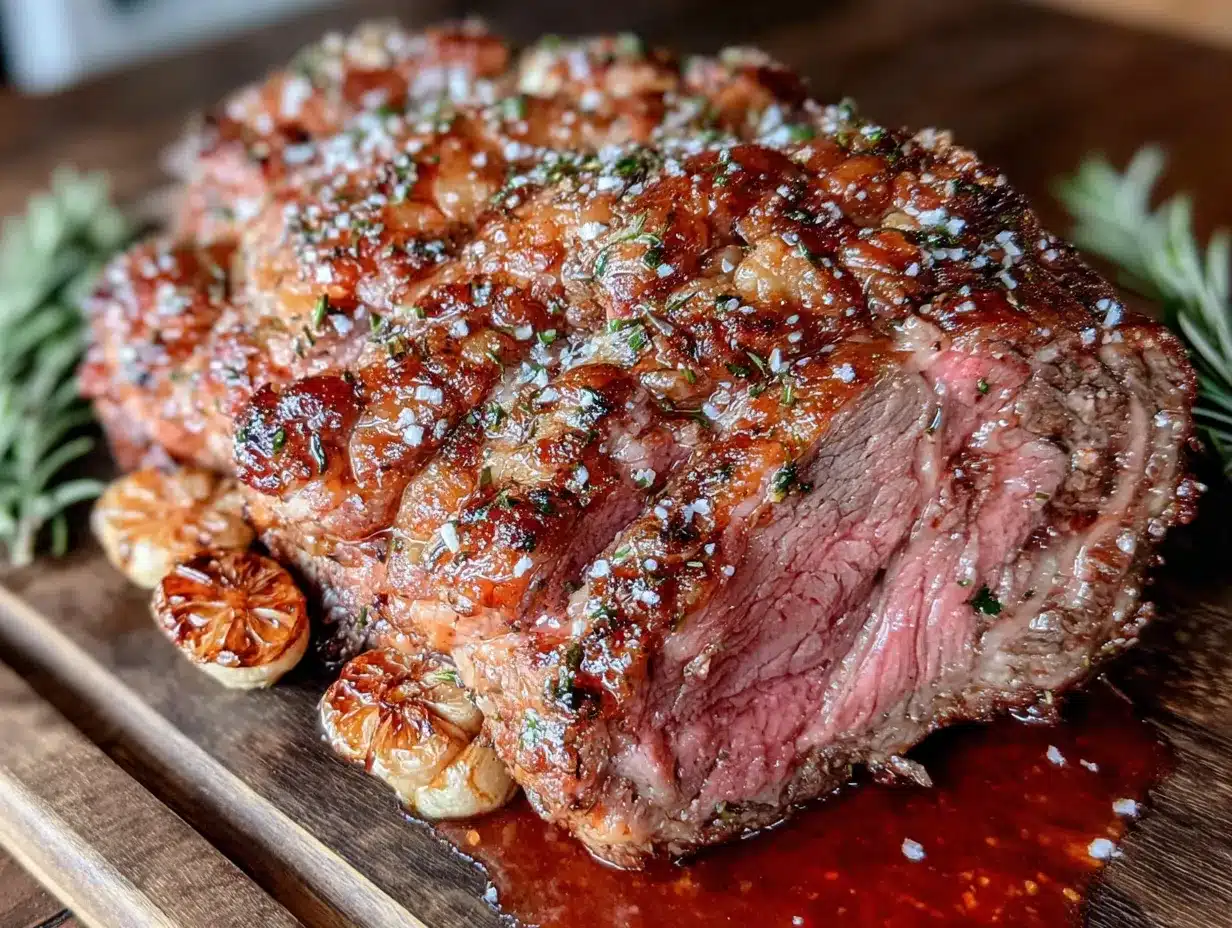
What makes this recipe different from the rest? It’s the reverse-sear method combined with a garlic-herb butter that gets slathered all over the roast before it goes into the oven. That butter bastes the meat as it slowly cooks, creating a crust that’s impossibly flavorful. And the jus? It comes together in the same pan while the roast rests, so you get all those browned bits and drippings without any extra fuss. This isn’t just another prime rib recipe—it’s your best version. The one you’ll pull out year after year.
What Ingredients You Will Need
This recipe uses simple, high-quality ingredients to deliver that showstopping flavor without a mile-long ingredient list. Most of these are pantry staples or easy to find at any grocery store.
For the Prime Rib Roast
- 1 (6-8 pound) bone-in prime rib roast (I prefer a 3-rib roast for even cooking; look for good marbling)
- 6 cloves garlic, minced (fresh only—don’t use the jarred stuff here, it lacks the punch)
- 4 tablespoons unsalted butter, softened (I use Kerrygold for the richness)
- 2 tablespoons fresh rosemary, finely chopped (about 3 sprigs)
- 2 tablespoons fresh thyme leaves (about 6 sprigs)
- 1 tablespoon kosher salt (Diamond Crystal is my go-to; if using Morton’s, use a little less)
- 1 teaspoon black pepper, freshly ground
- 1 teaspoon garlic powder (adds an extra layer of savory flavor)
For the Red Wine Jus
- 1 cup dry red wine (Cabernet Sauvignon or Merlot—something you’d actually drink)
- 2 cups beef broth (low-sodium, so you control the salt; I like Kitchen Basics)
- 2 tablespoons all-purpose flour (or cornstarch for a gluten-free option)
- 1 tablespoon unsalted butter
- 1 teaspoon fresh thyme leaves (optional, for garnish)
- Salt and pepper to taste
Ingredient Tips: For the best texture, let your prime rib sit at room temperature for about 2 hours before cooking. This ensures even cooking throughout. If you can’t find bone-in, a boneless roast works too—just reduce the cooking time slightly. I’ve used both, and honestly, the bone adds flavor and helps the meat stay juicy. For the red wine, don’t use cooking wine. Grab a bottle you’d enjoy sipping—it makes a real difference in the jus. If you’re avoiding alcohol, substitute with an equal amount of beef broth and a splash of balsamic vinegar for depth.
Equipment Needed
You don’t need a professional kitchen to pull this off, but a few key tools make the process smoother. Here’s what I use:
- Roasting pan with a rack (a heavy-duty one prevents warping; I got mine at a restaurant supply store for $25)
- Instant-read meat thermometer (ThermoPro is my favorite—it’s accurate and affordable; don’t skip this, guessing the temp is a disaster waiting to happen)
- Chef’s knife (a sharp one makes trimming and slicing effortless)
- Cutting board (wooden or plastic, with a groove to catch juices)
- Small bowl (for mixing the herb butter)
- Whisk (for the jus, to get it smooth)
- Aluminum foil (for tenting the roast while it rests)
- Kitchen twine (if your roast isn’t tied; ask your butcher to do it for you)
Pro Tip: If you don’t have a roasting rack, roll up a few pieces of foil into coils and place them under the roast. It lifts the meat off the pan bottom so it cooks evenly. I’ve done this in a pinch and it works like a charm.
Preparation Method
Take your time with this one. The active work is minimal, but patience pays off. Here’s exactly how I do it:
- Take the chill off the roast. Remove the prime rib from the refrigerator 2 hours before cooking. Pat it dry with paper towels—this is crucial for a good crust. Let it sit on a plate on the counter, uncovered. Don’t rush this step; cold meat cooks unevenly.
- Make the garlic herb butter. In a small bowl, combine the softened butter, minced garlic, chopped rosemary, thyme leaves, kosher salt, black pepper, and garlic powder. Mash it together with a fork until it’s a uniform paste. It should smell incredibly fragrant at this point. I always taste a tiny bit—yes, raw butter and garlic—to check the seasoning.
- Slather the roast. Place the prime rib on your cutting board, fat side up. Using your hands, rub the garlic herb butter all over the roast, covering every surface. Don’t be shy—get into the crevices between the bones. The butter acts as both a seasoning and a baste. Wash your hands well after this.
- Preheat and prep the pan. Preheat your oven to 250°F (120°C). Place the roast on the rack in your roasting pan, fat side up. Insert your meat thermometer into the thickest part of the meat, avoiding the bone. I aim for the center of the roast.
- Slow roast. Put the pan in the oven and roast until the internal temperature reaches 115°F (46°C) for rare, 125°F (52°C) for medium-rare, or 135°F (57°C) for medium. This usually takes about 3 to 4 hours for a 6-pound roast—roughly 30 minutes per pound. Don’t open the oven door too often; every time you do, heat escapes and adds cooking time. Set a timer for 2 hours, then start checking.
- Rest and crank the heat. Once the roast hits your target temperature, remove it from the oven. Transfer it to a cutting board and tent it loosely with foil. Let it rest for 30 minutes. Meanwhile, increase your oven temperature to 500°F (260°C).
- Sear the crust. After the rest, return the roast to the roasting pan (no rack needed) and pop it into the hot oven for 8 to 10 minutes. Watch it closely—you want a deep golden-brown crust, not a burnt one. The butter and herbs will sizzle and crisp up beautifully.
- Rest again. Remove the roast from the oven and tent it with foil again. Let it rest for another 10 to 15 minutes before carving. This second rest allows the juices to redistribute, so every slice is juicy.
- Make the red wine jus. While the roast rests, place the roasting pan on the stovetop over medium heat. (If your pan isn’t stovetop-safe, scrape the drippings into a saucepan.) Add the red wine and whisk, scraping up all the browned bits from the bottom of the pan. Let it simmer for 2 minutes to cook off the alcohol. Sprinkle in the flour and whisk constantly for 1 minute—this thickens the jus. Slowly pour in the beef broth while whisking. Bring to a simmer and cook for 3 to 4 minutes, until slightly thickened. Stir in the butter until melted. Season with salt and pepper to taste. Strain through a fine-mesh sieve if you want a silky jus (I usually don’t bother, I like the little herb bits).
- Carve and serve. Slice the roast between the bones into thick slices, about 1-inch thick. Arrange on a platter, spoon some jus over the top, and serve the rest on the side. Watch everyone go quiet.
Cooking Tips & Techniques
I’ve made this roast more times than I can count, and I’ve learned a few things the hard way. Here’s what I wish someone had told me:
- Don’t skip the resting periods. I know it’s tempting to carve right away, but the meat needs that time to relax. Cut too soon and all those beautiful juices end up on the cutting board instead of in your mouth. The first time I made this, I was so impatient I carved after just 10 minutes. The slices were dry and the kitchen floor looked like a crime scene. Learn from my mistake.
- Use a thermometer, not a timer. Ovens vary wildly. My friend’s oven runs 25 degrees hot, and she always overdoes her roasts. Trust the internal temperature, not the clock. Pull the roast 5 degrees before your target—it continues cooking while it rests.
- Let the butter come to room temperature. Cold butter doesn’t spread evenly over the meat. Leave it out for an hour before you start. If you forget, microwave it in 5-second bursts, but be careful not to melt it.
- Pat the roast dry. Moisture is the enemy of a good crust. If the meat is wet, the butter won’t stick and you’ll end up with a steamed, gray exterior. Take the extra minute to blot it with paper towels.
- Make the jus while the roast rests. This is a great multitasking moment. The pan drippings are at their peak flavor right after the roast comes out. Don’t let them cool and solidify—use them immediately for the best-tasting jus.
Variations & Adaptations
This recipe is flexible, and I’ve tried a few twists over the years. Here are some favorites:
- Herb Swap: Don’t have rosemary and thyme? Use 2 tablespoons of fresh oregano or sage instead. I once made this with only dried herbs in a pinch (use half the amount), and it was still delicious—just less vibrant. Fresh is always better here.
- Garlic Lover’s Version: Double the garlic. Yes, 12 cloves. Rub it all over the roast and watch the skeptics become believers. I did this for a friend who claimed to hate garlic (a lie, clearly), and he ate three slices.
- Red Wine-Free Jus: If you’re avoiding alcohol, skip the wine and use 1 cup of beef broth plus 2 tablespoons of balsamic vinegar. The vinegar adds acidity and depth that mimics the wine. It’s not identical, but it’s close enough that no one at my table noticed.
- Low-Carb Adaptation: Skip the flour in the jus and use 1 tablespoon of arrowroot powder or xanthan gum instead. The texture is slightly different—a bit glossier—but the flavor is spot on.
- Spicy Crust: Add 1 teaspoon of smoked paprika and ½ teaspoon of cayenne pepper to the herb butter. The heat cuts through the richness of the meat beautifully. I tried this for a New Year’s Eve party and it was a hit.
Serving & Storage Suggestions
This roast is best served warm, right after carving. Here’s how I like to present it:
- Serving Temperature: Serve the slices immediately after the second rest, while the jus is still hot. The meat should be warm, not steaming—that means it’s perfectly rested. Arrange the slices on a large platter, overlapping slightly, and spoon a little jus over the top. Garnish with fresh thyme sprigs for color.
- What to Serve With It: Creamy mashed potatoes are a no-brainer—they soak up the jus like a dream. Roasted asparagus or green beans add a fresh contrast. A simple arugula salad with lemon vinaigrette cuts through the richness. For bread, a crusty baguette or Yorkshire puddings are classic choices.
- Storage: Leftover prime rib keeps well in the refrigerator for up to 4 days. Wrap the slices tightly in foil or place them in an airtight container. The jus should be stored separately in a jar or container. Reheat the meat gently—I place slices in a skillet with a splash of beef broth over low heat, covered, for about 5 minutes. The microwave works in a pinch, but it can toughen the meat.
- Freezing: You can freeze cooked prime rib for up to 3 months. Wrap individual slices in plastic wrap, then foil, and place in a freezer bag. Thaw overnight in the refrigerator before reheating. The texture won’t be quite as perfect as fresh, but it’s still wonderful in sandwiches or on salads.
- Flavor Development: Honestly, the leftovers taste even better the next day. The flavors meld together overnight, and the jus thickens into this incredible savory jelly. I’ve been known to make extra just for cold roast beef sandwiches the next day—thinly sliced, on rye bread, with a smear of horseradish cream. Absolute heaven.
Nutritional Information & Benefits
Prime rib is a treat, no question, but it does offer some nutritional benefits. Here’s a rough breakdown per serving (based on a 6-ounce portion without jus):
- Calories: Approximately 450
- Protein: 45 grams
- Fat: 30 grams (including heart-healthy monounsaturated fats)
- Carbohydrates: 2 grams (from the herbs and garlic)
- Iron: 15% of the daily value
- Vitamin B12: 50% of the daily value
Beef is a fantastic source of high-quality protein and essential nutrients like iron, zinc, and B vitamins—all important for energy and immune function. The garlic and herbs add antioxidants and anti-inflammatory compounds. That said, this is a rich dish, so I balance it with lighter sides like roasted vegetables or a big green salad. It’s all about moderation, right? I don’t eat prime rib every week, but when I do, I savor every bite without guilt.
Dietary Considerations: This recipe is naturally low-carb and gluten-free if you use cornstarch or arrowroot in the jus. It’s not suitable for vegetarian or vegan diets, obviously. If you have guests with dietary restrictions, consider serving a hearty mushroom Wellington alongside—it’s a lovely complement.
Conclusion
This Perfect Garlic Herb Prime Rib Roast with Red Wine Jus is more than just a recipe—it’s the one that changed my mind about what I could pull off in the kitchen. I stopped being afraid of expensive cuts of meat and started trusting the process. The reverse-sear method, the garlic herb butter, the rich jus—it all comes together to create a meal that feels both special and totally doable. You don’t need to be a professional chef to make this. You just need a little patience, a good thermometer, and the willingness to prove yourself wrong.
I’d love to hear how it goes for you. Did you try a different herb combination? Did your family go quiet like mine did? Leave a comment below and let me know—I read every single one. And if you share a photo on Pinterest or Instagram, tag me so I can see your beautiful roast. Trust me, once you make this, you’ll be looking for excuses to make it again. Happy cooking, friends.
Frequently Asked Questions
Can I use a boneless prime rib roast for this recipe?
Yes, you can. Boneless roasts cook a bit faster—check the temperature about 20 minutes earlier than you would for a bone-in roast. The flavor is slightly less intense without the bone, but it’s still delicious. Just make sure to tie it with kitchen twine so it holds its shape.
What if I don’t have a meat thermometer?
I really recommend getting one—it’s the only reliable way to know when your roast is done. But if you’re in a pinch, you can use the hand test: press the center of the roast with your finger. If it feels like the fleshy part of your palm below your thumb when your hand is relaxed, it’s rare. If it feels firmer, like when you touch your thumb to your middle finger, it’s medium-rare. It’s not perfect, but it works in a bind.
Can I prepare the garlic herb butter in advance?
Absolutely. Make the butter up to 3 days ahead and keep it covered in the refrigerator. Let it come to room temperature for about 30 minutes before spreading it on the roast. You can also freeze it for up to 3 months—just wrap it tightly in plastic wrap and thaw overnight in the fridge.
Why is my prime rib tough?
Tough prime rib usually means it was overcooked or not rested long enough. The meat fibers tighten up when exposed to high heat, and resting allows them to relax. If you hit your target temperature and let it rest properly, it should be tender. Also, make sure you’re buying a roast with good marbling—the fat keeps it moist during cooking.
Can I make the red wine jus ahead of time?
Yes, you can make the jus up to 2 days in advance. Let it cool completely, then store it in an airtight container in the refrigerator. Reheat it gently on the stovetop over low heat, whisking occasionally. If it thickens too much, add a splash of beef broth to thin it out. I actually think the flavor deepens overnight—it’s even better the next day.
Pin This Recipe!
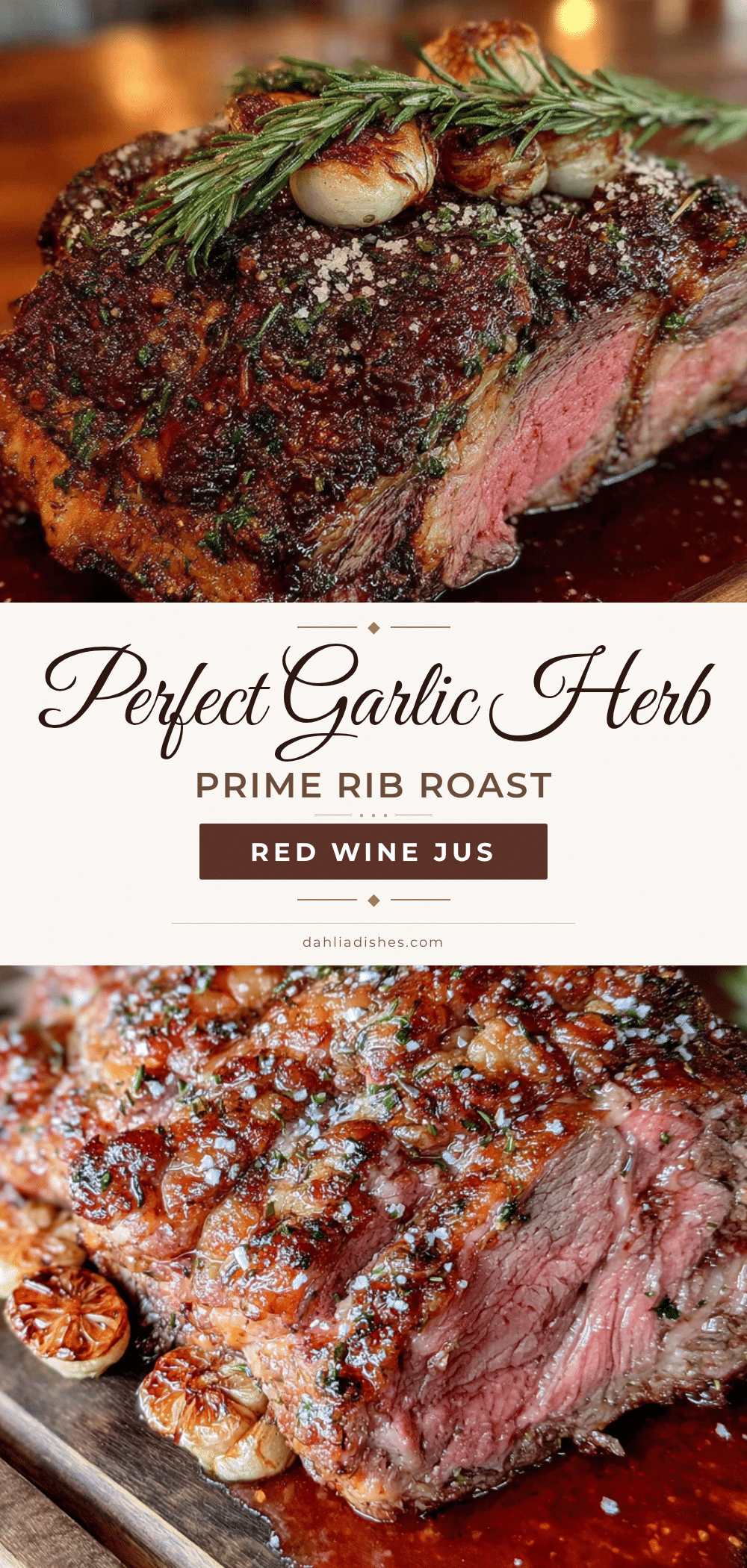
Perfect Garlic Herb Prime Rib Roast with Easy Red Wine Jus
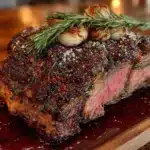
This foolproof prime rib roast uses the reverse-sear method for evenly cooked, buttery tender meat with a fragrant garlic herb crust and a rich red wine jus. Perfect for special occasions, it’s a crowd-pleaser that makes you look like a pro.
- Prep Time: 20 minutes
- Cook Time: 3 hours 30 minutes
- Total Time: 4 hours 20 minutes
- Yield: 8 servings 1x
- Category: Main Course
- Cuisine: American
Ingredients
- 1 (6-8 pound) bone-in prime rib roast
- 6 cloves garlic, minced
- 4 tablespoons unsalted butter, softened
- 2 tablespoons fresh rosemary, finely chopped
- 2 tablespoons fresh thyme leaves
- 1 tablespoon kosher salt
- 1 teaspoon black pepper, freshly ground
- 1 teaspoon garlic powder
- 1 cup dry red wine (Cabernet Sauvignon or Merlot)
- 2 cups low-sodium beef broth
- 2 tablespoons all-purpose flour
- 1 tablespoon unsalted butter
- 1 teaspoon fresh thyme leaves (optional, for garnish)
- Salt and pepper to taste
Instructions
- Remove the prime rib from the refrigerator 2 hours before cooking. Pat it dry with paper towels and let it sit on a plate on the counter, uncovered.
- In a small bowl, combine the softened butter, minced garlic, chopped rosemary, thyme leaves, kosher salt, black pepper, and garlic powder. Mash together with a fork until a uniform paste forms.
- Place the prime rib on a cutting board, fat side up. Rub the garlic herb butter all over the roast, covering every surface, including between the bones.
- Preheat the oven to 250°F (120°C). Place the roast on a rack in a roasting pan, fat side up. Insert a meat thermometer into the thickest part of the meat, avoiding the bone.
- Roast until the internal temperature reaches 115°F (46°C) for rare, 125°F (52°C) for medium-rare, or 135°F (57°C) for medium. This takes about 3 to 4 hours for a 6-pound roast (roughly 30 minutes per pound).
- Remove the roast from the oven. Transfer it to a cutting board and tent loosely with foil. Let it rest for 30 minutes. Meanwhile, increase the oven temperature to 500°F (260°C).
- After the rest, return the roast to the roasting pan (no rack needed) and place it in the hot oven for 8 to 10 minutes, until a deep golden-brown crust forms.
- Remove the roast from the oven and tent with foil again. Let it rest for another 10 to 15 minutes before carving.
- While the roast rests, place the roasting pan on the stovetop over medium heat. Add the red wine and whisk, scraping up browned bits. Simmer for 2 minutes. Sprinkle in the flour and whisk constantly for 1 minute. Slowly pour in the beef broth while whisking. Bring to a simmer and cook for 3 to 4 minutes, until slightly thickened. Stir in the butter until melted. Season with salt and pepper to taste. Strain if desired.
- Slice the roast between the bones into 1-inch thick slices. Arrange on a platter, spoon some jus over the top, and serve the rest on the side.
Notes
Let the roast sit at room temperature for 2 hours before cooking for even cooking. Don’t skip the resting periods; they ensure juicy meat. Use a meat thermometer for accuracy. Pat the roast dry for a good crust. Make the jus while the roast rests for best flavor.
Nutrition
- Serving Size: 6 ounces
- Calories: 450
- Sodium: 600
- Fat: 30
- Saturated Fat: 12
- Carbohydrates: 2
- Protein: 45
Keywords: prime rib, garlic herb prime rib, reverse sear prime rib, red wine jus, holiday roast, Christmas dinner, New Year's Eve dinner