Love this? Save it for later!
Share the inspiration with your friends
I swore I didn’t like Pan de Muerto. For years. The dry, crumbly versions I’d tried from bakeries always left me reaching for a glass of water, wondering what the big deal was about this so-called “bread of the dead.” It felt like a betrayal of my own heritage to admit it, but there it was. Then last October, my friend Rosa caught me picking at a piece she’d brought to our book club, and she just laughed.
“That’s because you’ve been eating the wrong ones,” she said, pushing the whole plate toward me. “Those bakery ones sit out for days. You need one that’s still warm, still soft, with the butter barely melted into the crumb.” She was right, of course. But what really got me was the glaze—this delicate, floral orange blossom situation that turned the whole thing from a dry cookie into something almost like a cloud. I mean, honestly, I ate three pieces before I even realized what I was doing.
That night, I went home and started experimenting. I wanted that same pillowy texture, that same fragrant sweetness, but I wanted to make it myself—from scratch, in my own kitchen, on a chilly Tuesday night when I needed something to do with my hands. The first batch was a disaster. Too dense, like little orange-scented hockey pucks. The second batch? Better. The third? That was the one. The one where I finally understood what all the fuss was about.
Maybe you’ve been there too—dismissing a recipe for years only to discover you just hadn’t had the right version. This cozy Pan de Muerto with Orange Blossom Glaze is that version. It’s the kind of bread that makes you close your eyes after the first bite, the kind that fills your kitchen with the warmest, most comforting scent imaginable. And honestly? It’s the recipe that finally made me a believer.
Why You’ll Love This Recipe
Let me tell you why this particular Pan de Muerto is worth your time, your flour, and your precious counter space. I’ve tested this recipe more times than I care to admit, and every single tweak was made with one goal in mind: creating a bread that feels like a warm hug on a cold day.
- Incredibly Soft & Pillowy: This isn’t that dry, crumbly bread you’ve had before. The enriched dough, with just the right amount of butter and eggs, bakes up tender and light, with a texture that practically melts in your mouth.
- Simple, Approachable Ingredients: No weird specialty flours or hard-to-find extracts here. You probably already have most of what you need in your pantry—flour, sugar, butter, eggs, yeast. The only “special” ingredient is the orange blossom water, and trust me, one bottle will last you through many batches.
- Perfect for Cozy Evenings: This is the recipe you make when the weather turns cold, when you need something to do with your hands on a slow Sunday, or when you want to fill your home with the most comforting, nostalgic aroma imaginable.
- Authentic Yet Approachable: I’ve streamlined the traditional method without losing any of the soul. The dough comes together easily, the shaping is simpler than it looks, and the results are genuinely impressive.
- That Orange Blossom Glaze: Oh, that glaze. It’s not too sweet, not too floral—just perfectly balanced, with a hint of citrus that complements the warm, yeasty bread beautifully. It’s what makes this recipe truly special.
This isn’t just another bread recipe. It’s the kind you’ll find yourself making year after year, the kind your family will start requesting before the leaves even start changing. It’s comfort food, reimagined—traditional, yes, but with a softness and warmth that feels made for right now.
What Ingredients You Will Need
This recipe uses simple, wholesome ingredients that work together to create something truly magical. The key is in the quality and the preparation—using room-temperature ingredients, good butter, and that special orange blossom water that makes everything sing.
For the Dough
- All-purpose flour – 4 cups (500g), plus more for dusting. I prefer King Arthur for its consistent protein content, but any good brand works.
- Active dry yeast – 2 ¼ teaspoons (one standard packet). Make sure it’s fresh—check the expiration date before you start.
- Warm milk – ½ cup (120ml), heated to about 110°F. Whole milk gives the richest flavor, but 2% works too.
- Granulated sugar – ½ cup (100g), divided. We’ll use a pinch to activate the yeast and the rest in the dough.
- Unsalted butter – ½ cup (113g), softened to room temperature. Please don’t use margarine—the flavor difference is huge.
- Large eggs – 3, room temperature. Cold eggs will shock your dough and make it harder to rise.
- Orange zest – 2 tablespoons, from about 2 large oranges. Use organic if you can—you’ll really taste the difference.
- Vanilla extract – 1 teaspoon. Pure vanilla, not imitation, for the best depth of flavor.
- Salt – 1 teaspoon. Fine sea salt is my go-to.
- Orange blossom water – 1 tablespoon. This is the star—look for it in the international aisle or a Middle Eastern grocery. A little goes a long way.
For the Orange Blossom Glaze
- Powdered sugar – 1 ½ cups (180g), sifted to avoid lumps.
- Orange blossom water – 2 tablespoons.
- Fresh orange juice – 2-3 tablespoons, as needed for consistency.
- Orange zest – 1 teaspoon, for garnish.
- Unsalted butter – 2 tablespoons, melted (optional, for a richer glaze).
For Finishing
- Egg wash – 1 egg beaten with 1 tablespoon of water, for that beautiful golden sheen.
- Sanding sugar – Optional, for a sparkly finish. Coarse turbinado sugar works beautifully too.
Ingredient Selection Tips: When choosing orange blossom water, look for a brand that lists only orange blossom distillate and water—no added sugars or preservatives. I’ve had great luck with Cortas brand. And for the oranges themselves, give them a good wash before zesting—you don’t want any wax or pesticides in your beautiful bread.
Equipment Needed
You don’t need a professional bakery setup to make this bread, but having the right tools makes the process smoother and more enjoyable. Here’s what I use:
- Stand mixer with dough hook – This is my preferred method. It does the kneading work for you, and the dough comes together beautifully. A KitchenAid is my go-to, but any sturdy mixer works.
- Large mixing bowl – For rising the dough. Glass or ceramic is best—plastic can retain odors.
- Baking sheets – Two, lined with parchment paper. I like the half-sheet size for even baking.
- Instant-read thermometer – Not strictly necessary, but it helps ensure your milk is at the right temperature for the yeast. I killed a lot of yeast before I got one of these.
- Pastry brush – For the egg wash and the glaze. A silicone one is easiest to clean.
- Rasp grater or microplane – For zesting the oranges. A box grater works too, but a microplane gives you that fine, fluffy zest that melts right into the dough.
- Rolling pin – Optional, but helpful for shaping the decorative “bones.”
- Wire cooling rack – Essential for cooling the bread properly. If you let it cool on the pan, the bottom can get soggy.
Budget-Friendly Options: If you don’t have a stand mixer, you can absolutely knead this dough by hand. It takes about 10-12 minutes of good, solid kneading, and honestly? There’s something meditative about it. Just make sure you’re using a sturdy surface and a bit of patience.
Preparation Method
Alright, let’s make some bread. This recipe takes about 3 hours from start to finish, but most of that is rising time—time you can spend reading, watching a movie, or just enjoying the smell of yeast and orange zest filling your kitchen.
- Activate the yeast (5 minutes): In the bowl of your stand mixer, combine the warm milk (110°F), 1 tablespoon of the sugar, and the active dry yeast. Give it a gentle stir, then let it sit for 5-10 minutes until it’s foamy and fragrant. If it doesn’t foam, your yeast might be dead—start over with fresh yeast. I learned this the hard way, and it’s a sad, sad moment.
- Mix the dough (10 minutes): Add the remaining sugar, the softened butter, eggs, orange zest, vanilla extract, orange blossom water, and salt to the yeast mixture. Stir gently to combine. Add the flour, one cup at a time, mixing on low speed with the dough hook. Once all the flour is incorporated, increase the speed to medium and knead for 8-10 minutes. The dough should be smooth, elastic, and slightly tacky but not sticky. If it’s too sticky, add a tablespoon of flour at a time. If it’s too dry, add a teaspoon of warm milk.
- First rise (1-1.5 hours): Shape the dough into a smooth ball and place it in a lightly greased bowl, turning once to coat. Cover with plastic wrap or a clean kitchen towel and let it rise in a warm, draft-free spot until doubled in size. I like to put mine in the microwave (turned off) with a cup of hot water next to it for a cozy, humid environment. This usually takes about 60-90 minutes, depending on how warm your kitchen is.
- Shape the loaves (15 minutes): Punch down the risen dough gently to release the air. Turn it out onto a lightly floured surface. Divide the dough into two equal pieces. Set one piece aside. From the other piece, pinch off about ¼ cup of dough and set it aside for the decorative “bones.” Shape the larger piece into a smooth, round ball and place it on a parchment-lined baking sheet. Repeat with the second piece of dough. Now, take the reserved dough and divide it into 6-8 small pieces. Roll each piece into a rope about 4-5 inches long. These will be your “bones.” Gently press the ropes onto the top of each round loaf, arranging them in a cross pattern or a simple spoke design. Traditionally, Pan de Muerto has four “bones” arranged like a cross, but honestly? Do whatever feels right to you.
- Second rise (45-60 minutes): Cover the shaped loaves loosely with plastic wrap or a clean towel and let them rise again until puffy and almost doubled. This second rise is crucial for that soft, pillowy texture we’re after. Don’t rush it.
- Preheat and bake (25-30 minutes): About 20 minutes before the second rise is done, preheat your oven to 350°F (175°C). Brush the risen loaves gently with the egg wash, being careful not to deflate them. Bake for 25-30 minutes, rotating the pans halfway through, until the bread is deep golden brown and sounds hollow when tapped on the bottom. The internal temperature should read about 190°F on an instant-read thermometer.
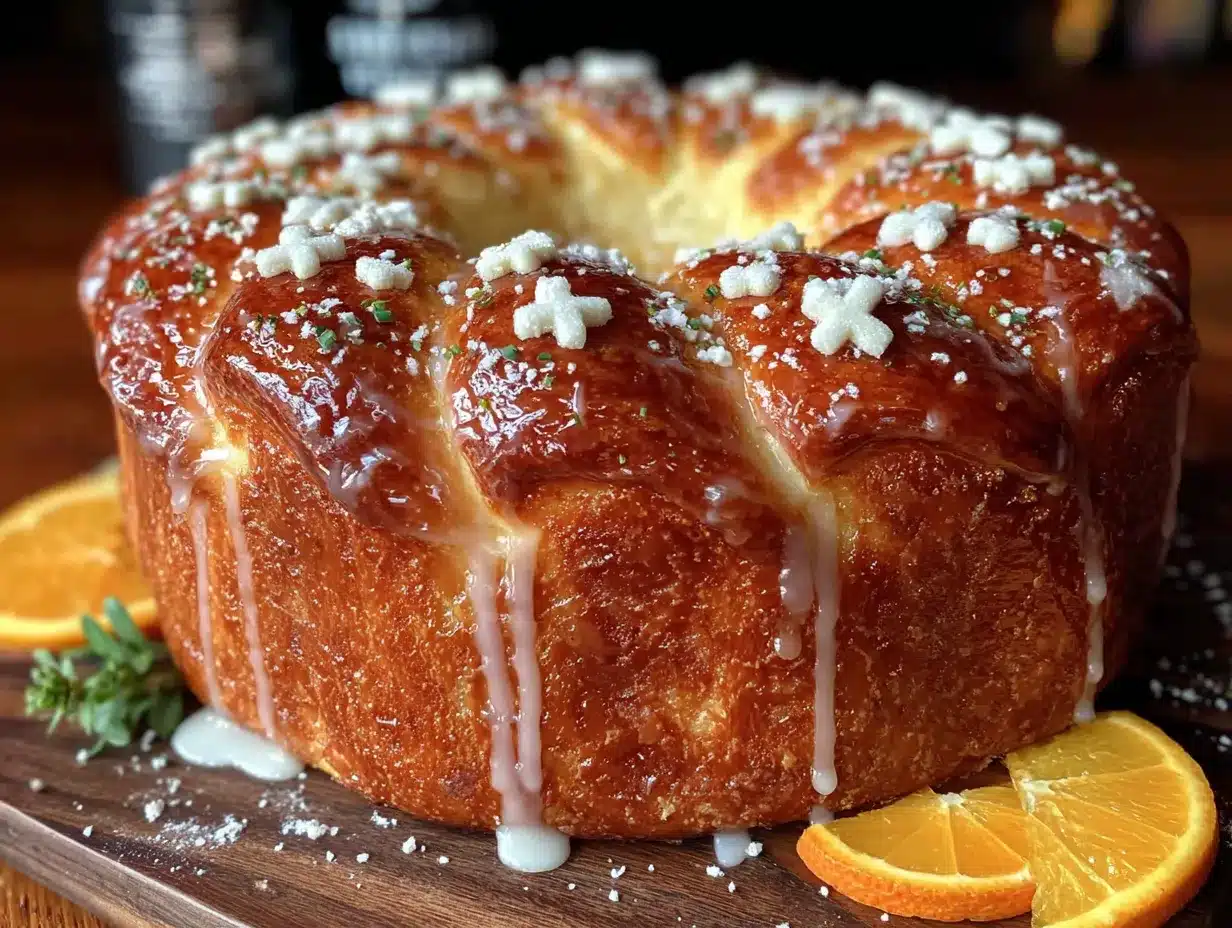
- Glaze while warm (5 minutes): While the bread is still warm (but not hot—let it cool for about 10 minutes on the pan), whisk together the glaze ingredients. Start with the powdered sugar and orange blossom water, then add orange juice a tablespoon at a time until you reach a thick but pourable consistency. Drizzle the glaze generously over the warm loaves, letting it drip down the sides. Sprinkle with the remaining orange zest and, if you’re feeling fancy, a little sanding sugar.
- Cool completely (1 hour): Transfer the glazed loaves to a wire rack to cool completely. I know it’s tempting to tear into it right away, but the glaze needs time to set, and the bread needs to finish cooking internally. Trust me—it’s worth the wait.
Sensory Cues: When the dough is properly kneaded, it should feel like a baby’s bottom—smooth, soft, and slightly springy. When it’s risen, it should look puffy and pillowy, and when you poke it gently, the indentation should slowly spring back. When it’s baked, the kitchen should smell like a warm, orange-scented cloud.
Cooking Tips & Techniques
After making this recipe more times than I can count (and messing it up plenty along the way), I’ve gathered some tips that will save you time, frustration, and maybe a few tears.
Temperature is everything. I cannot stress this enough. Your milk needs to be warm—around 110°F—but not hot. If it’s too hot, it will kill the yeast. If it’s too cold, the yeast won’t activate. An instant-read thermometer is your best friend here. Also, make sure your eggs and butter are truly at room temperature. Cold ingredients will make your dough dense and stubborn. I’ve been known to put my eggs in a bowl of warm water for 5 minutes if I forget to take them out ahead of time.
Don’t over-flour your surface. When shaping the dough, use as little flour as possible. Too much flour will make the bread dry and tough. If the dough is sticking, try using a bench scraper to lift and fold it instead of adding more flour. A light dusting is all you need.
Watch the glaze. The glaze should be thick enough to coat the back of a spoon but thin enough to drizzle. If it’s too thick, add a little more orange juice. If it’s too thin, add a bit more powdered sugar. And don’t skip the orange blossom water—it’s what gives this bread its signature floral aroma. A little goes a long way, but without it, you’re just making orange bread.
My biggest failure: The first time I made this, I forgot the salt. The bread was bland, flat, and honestly? A little sad. Salt isn’t just for flavor—it strengthens the gluten structure and helps control the yeast’s activity. Don’t skip it. Another time, I over-proofed the dough because I got distracted by a movie. The bread collapsed in the oven and came out dense and sad. Set a timer, people. Learn from my mistakes.
Multitasking strategy: While the dough is rising for the first time, make the glaze and zest your oranges. While it’s rising the second time, clean up your kitchen and preheat the oven. This way, when the bread comes out, you’re ready to go, and you’re not scrambling to whisk glaze while the bread cools.
Variations & Adaptations
One of the things I love most about this recipe is how adaptable it is. Here are a few variations I’ve tried and loved:
Chocolate Orange Version: Add ½ cup of mini chocolate chips to the dough along with the flour. The combination of orange blossom and dark chocolate is absolutely divine. I made this for a friend who “doesn’t like” traditional Pan de Muerto, and she ate half a loaf in one sitting. It’s that good.
Vegan Adaptation: Replace the butter with vegan butter (I like Miyoko’s), the eggs with flax eggs (1 tablespoon ground flaxseed + 3 tablespoons water per egg), and the milk with oat milk. The texture will be slightly denser, but the flavor is still lovely. Just make sure your vegan butter is truly softened to room temperature.
Gluten-Free Option: Use a good 1:1 gluten-free flour blend (I’ve had success with King Arthur Measure for Measure). The dough will be stickier and harder to shape, so you might want to use a little extra flour on your hands. The texture won’t be quite as pillowy, but it’s still delicious. I actually prefer the gluten-free version for toast the next day—it gets beautifully crisp.
Spiced Variation: Add 1 teaspoon of ground cinnamon and ½ teaspoon of ground cardamom to the flour mixture. The warm spices pair beautifully with the orange blossom and make the bread even more cozy and aromatic. This is my go-to version for cold, rainy days.
Lemon-Anise Twist: Swap the orange zest for lemon zest and add 1 teaspoon of crushed anise seeds to the dough. The licorice-like flavor of anise is surprisingly wonderful with the floral glaze. It’s a little unconventional, but trust me—it works.
Serving & Storage Suggestions
This bread is at its absolute best on the day it’s made, still slightly warm from the oven, with the glaze soft and glossy. But let’s be real—it’s also pretty amazing the next day, toasted and slathered with butter.
Serving Temperature: Serve at room temperature or slightly warm. If you’re reheating a slice, pop it in a toaster oven at 300°F for about 5 minutes. The edges get slightly crispy while the inside stays soft and tender. It’s perfection with a cup of coffee or a mug of Mexican hot chocolate.
What to Serve With It: A simple cup of café de olla (Mexican spiced coffee) is my favorite pairing. The cinnamon and piloncillo in the coffee complement the orange blossom beautifully. For a more indulgent treat, serve it with a dollop of crema or a scoop of vanilla ice cream. Honestly, it’s also incredible just on its own, torn apart piece by piece while you stand in the kitchen.
Storage Instructions: Store the bread in an airtight container at room temperature for up to 3 days. Do not refrigerate—the cold will dry it out and make it stale faster. If you need to keep it longer, wrap it tightly in plastic wrap and then foil, and freeze for up to 2 months. To thaw, let it sit at room temperature for a few hours, then warm it in a low oven for 10 minutes.
Flavor Development: Here’s a little secret—the flavor actually gets better on the second day. The orange blossom water has time to permeate every bite, and the crumb becomes even more tender. If you can resist eating it all on day one, you’re in for a treat on day two.
Nutritional Information & Benefits
Let’s be honest—this is a treat, not a health food. But that doesn’t mean it doesn’t have its merits. Here’s a rough breakdown per serving (1/8 of a loaf):
| Nutrient | Amount |
|---|---|
| Calories | ~320 |
| Total Fat | 12g |
| Saturated Fat | 7g |
| Carbohydrates | 48g |
| Sugar | 22g |
| Protein | 6g |
| Fiber | 1g |
| Sodium | 290mg |
Health Highlights: The orange zest provides a good dose of vitamin C and antioxidants. The eggs add high-quality protein and healthy fats. And honestly? There’s something to be said for the mental health benefits of taking time to make something beautiful and delicious with your own hands. This bread is an act of self-care, and that counts for something.
Dietary Considerations: This recipe contains gluten, dairy, and eggs. For a gluten-free or vegan option, see the variations section above. The sugar content is moderate for a sweet bread, but you can reduce the sugar in the dough by 2 tablespoons if you prefer a less sweet loaf.
Conclusion
This cozy Pan de Muerto with Orange Blossom Glaze is more than just a recipe—it’s a little piece of comfort that you can create in your own kitchen. It’s the bread that finally made me understand what all the fuss was about, and I have a feeling it might do the same for you.
Whether you’re making it for Día de Muertos, a cozy fall evening, or just because you need something beautiful to bake, this bread delivers. It’s soft, fragrant, and deeply satisfying—the kind of recipe that feels like a warm hug on a cold day. And that orange blossom glaze? It’s pure magic.
I’d love to hear how yours turns out. Did you try a variation? Did you add extra orange zest? Did you eat half the loaf before it even cooled? (No judgment here—I’ve been there.) Drop a comment below and let me know. And if you share it on social media, tag me—I want to see your beautiful bread.
Go ahead, preheat that oven. Your kitchen is about to smell incredible.
Frequently Asked Questions
Can I make the dough ahead of time?
Absolutely. After the first rise, punch down the dough, wrap it tightly in plastic wrap, and refrigerate for up to 24 hours. When you’re ready to bake, let it come to room temperature for about an hour before shaping and proceeding with the second rise.
My dough isn’t rising. What went wrong?
Most likely, your yeast is dead. Make sure your milk was at the right temperature (110°F) and that your yeast wasn’t expired. Also, check that your kitchen isn’t too cold—a drafty room can slow down rising significantly. Try placing the bowl in a warm spot, like on top of the fridge or in the microwave with a cup of hot water.
Can I skip the orange blossom water?
You can, but it won’t be the same. The orange blossom water gives this bread its distinctive floral aroma and flavor. If you don’t have it, you can substitute with 2 tablespoons of fresh orange juice and an extra ½ teaspoon of vanilla extract. It’ll still be delicious, just different.
How do I know when the bread is fully baked?
The bread should be deep golden brown, and it should sound hollow when you tap the bottom. For absolute certainty, use an instant-read thermometer—the internal temperature should be around 190°F. If you don’t have a thermometer, a toothpick inserted into the center should come out clean or with a few moist crumbs.
Can I freeze the unbaked shaped loaves?
Yes! After shaping the loaves on the baking sheet, place them in the freezer until solid, then wrap tightly in plastic wrap and foil. When you’re ready to bake, thaw them in the refrigerator overnight, then let them come to room temperature and complete the second rise before baking. The texture will be just as good as fresh.
Pin This Recipe!
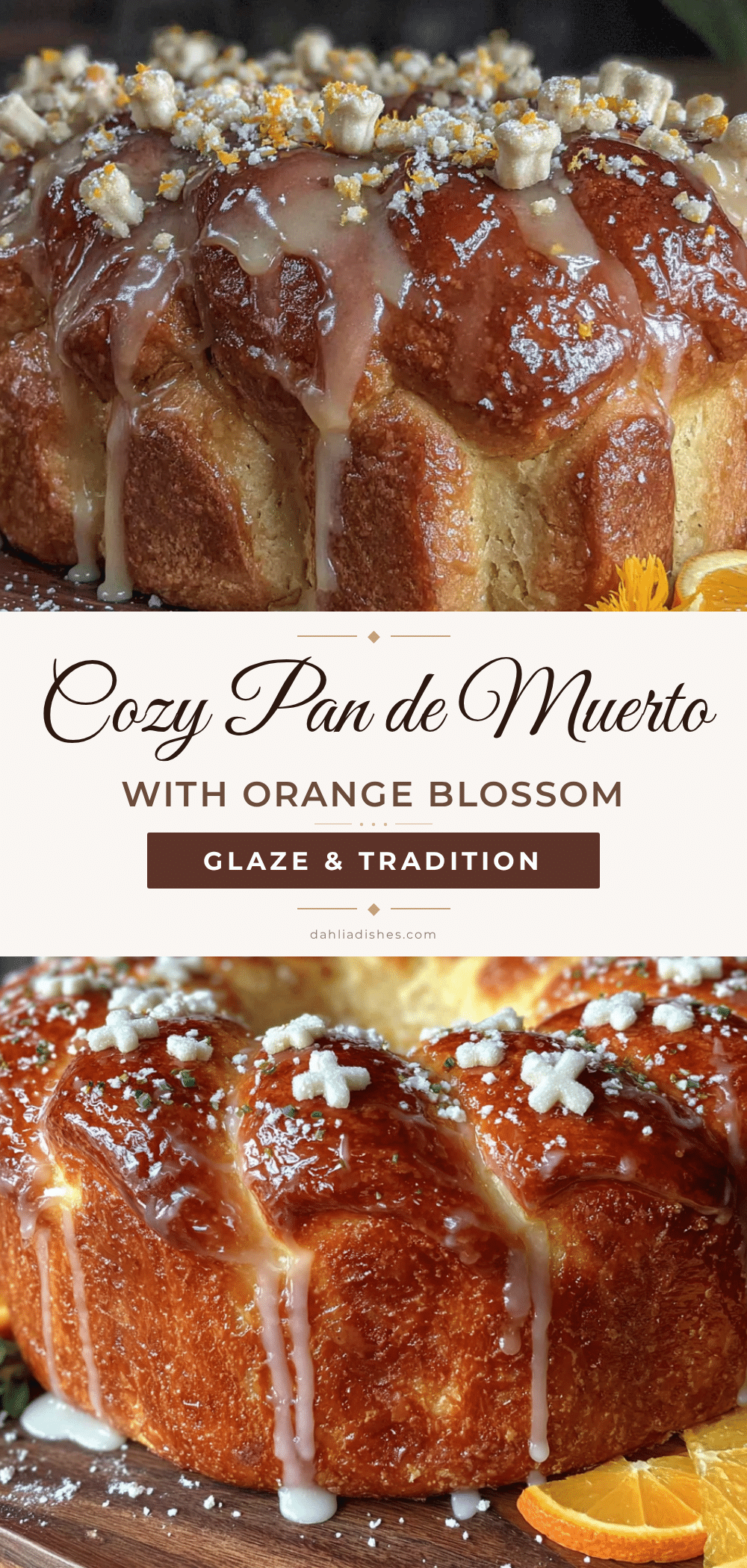
Cozy Pan de Muerto with Orange Blossom Glaze

This soft, pillowy Pan de Muerto is enriched with butter and eggs, scented with orange blossom water, and topped with a delicate floral glaze. It’s the perfect cozy bread for Día de Muertos or any chilly evening.
- Prep Time: 30 minutes
- Cook Time: 30 minutes
- Total Time: 3 hours (including rising time)
- Yield: 2 loaves (16 servings) 1x
- Category: Bread
- Cuisine: Mexican
Ingredients
- 4 cups (500g) all-purpose flour, plus more for dusting
- 2 ¼ teaspoons (1 packet) active dry yeast
- ½ cup (120ml) warm milk (about 110°F)
- ½ cup (100g) granulated sugar, divided
- ½ cup (113g) unsalted butter, softened
- 3 large eggs, room temperature
- 2 tablespoons orange zest (from about 2 oranges)
- 1 teaspoon vanilla extract
- 1 teaspoon fine sea salt
- 1 tablespoon orange blossom water
- 1 ½ cups (180g) powdered sugar, sifted
- 2 tablespoons orange blossom water (for glaze)
- 2–3 tablespoons fresh orange juice (for glaze)
- 1 teaspoon orange zest (for garnish)
- 2 tablespoons unsalted butter, melted (optional, for richer glaze)
- 1 egg beaten with 1 tablespoon water (for egg wash)
- Sanding sugar (optional, for finishing)
Instructions
- Activate the yeast: In the bowl of a stand mixer, combine warm milk (110°F), 1 tablespoon of the sugar, and the active dry yeast. Stir gently and let sit for 5-10 minutes until foamy.
- Mix the dough: Add remaining sugar, softened butter, eggs, orange zest, vanilla extract, orange blossom water, and salt to the yeast mixture. Stir gently. Add flour one cup at a time, mixing on low with the dough hook. Once all flour is incorporated, knead on medium speed for 8-10 minutes until smooth and elastic.
- First rise: Shape dough into a smooth ball and place in a lightly greased bowl, turning once to coat. Cover and let rise in a warm, draft-free spot until doubled in size, about 1-1.5 hours.
- Shape the loaves: Punch down dough and turn onto a lightly floured surface. Divide into two equal pieces. From one piece, pinch off about ¼ cup of dough for decorative ‘bones.’ Shape the larger piece into a smooth round ball and place on a parchment-lined baking sheet. Repeat with second piece. Divide reserved dough into 6-8 small pieces, roll each into a 4-5 inch rope, and press onto the tops of the loaves in a cross or spoke pattern.
- Second rise: Cover shaped loaves loosely and let rise until puffy and almost doubled, about 45-60 minutes.
- Preheat and bake: About 20 minutes before second rise is done, preheat oven to 350°F (175°C). Brush risen loaves gently with egg wash. Bake for 25-30 minutes, rotating pans halfway, until deep golden brown and hollow when tapped. Internal temperature should reach about 190°F.
- Glaze while warm: Let bread cool on pan for 10 minutes. Whisk together powdered sugar, 2 tablespoons orange blossom water, and enough orange juice to reach a thick but pourable consistency. Drizzle over warm loaves. Sprinkle with remaining orange zest and sanding sugar if desired.
- Cool completely: Transfer glazed loaves to a wire rack to cool completely before serving.
Notes
Temperature is key: milk should be 110°F, eggs and butter at room temperature. Don’t over-flour the surface when shaping. The glaze should be thick but pourable; adjust with orange juice or powdered sugar as needed. For best flavor, use high-quality orange blossom water (like Cortas). The bread keeps at room temperature for up to 3 days or frozen for 2 months.
Nutrition
- Serving Size: 1/8 of a loaf
- Calories: 320
- Sugar: 22
- Sodium: 290
- Fat: 12
- Saturated Fat: 7
- Carbohydrates: 48
- Fiber: 1
- Protein: 6
Keywords: Pan de Muerto, Day of the Dead bread, orange blossom, Mexican sweet bread, soft bread, holiday bread